Mini Countryman SE: Fun, Flawed EV SUV Misses Top Spot
The 2025 Mini Countryman SE All4, while a contender with undeniable charisma and a personality built for accolades, ultimately falls short of securing a top spot in our rigorous SUV of the Year evaluations. Despite its captivating style and engaging driving dynamics, critical shortcomings in key areas prevent it from advancing to the finalist round.
Distinctive Design, Inside and Out
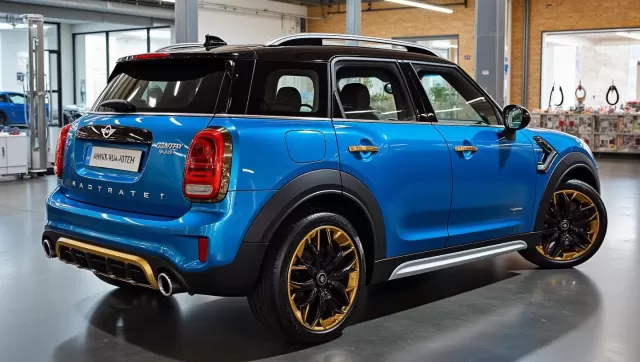
Mini's design language is always a conversation starter, and the Countryman SE is no exception. The Blazing Blue Metallic paint on our test model, accented by stylish gold detailing, creates a striking visual. The British flag motif in the taillights is a charming touch, and thankfully, the rear turn signals have shed their previous awkward orientation.
Step inside, and the cabin continues the theme of unique design. Gold accents adorn the door handles and air vents, complementing the textile surfacing that covers the doors, dashboard, and center console. This tactile approach imbues the interior with a sense of individuality rarely found in competitors.
A Thrill on Twisty Roads
The Countryman SE truly shines when the pavement begins to curve. Engaging "Go Kart" mode unleashes a playful spirit, complete with a "woohoo" sound effect reminiscent of classic video games and a clear notification that dynamic stability control is dialed back. Features editor Scott Evans noted, "You can totally ride out a little drift once you get the rear end unloaded. This Mini is stupid fun." This spirited performance undeniably fulfills our "performance of intended function" criterion, delivering an exhilarating driving experience.
City-Friendly Agility
Beyond its sporty capabilities, the electric Mini proves itself a capable city dweller. It navigates rough and choppy surfaces with impressive damping, offering a comfortable ride. The 308-horsepower dual-motor all-wheel-drive system provides punchy, yet manageable, power delivery that is more than ample for everyday driving.
Safety First
Our safety assessments confirm that the Countryman SE provides a secure environment for occupants. Building on the gas-only model's IIHS Top Safety Pick rating, the electric version is well-equipped. Judges found the adaptive cruise control and lane keep assist systems intuitive and easy to operate, contributing to a confident driving experience.
Where the Countryman SE Stumbles
Despite its many charms, the Countryman SE grapples with significant issues that hinder its overall excellence. While the powertrain and suspension tuning are commendable, the infotainment system presents a notable challenge. The circular display, though featuring sharp graphics, suffers from frustratingly slow responsiveness. The attempt to integrate retro-inspired skins with various drive modes, while conceptually interesting, becomes a cumbersome experience when graphic lag forces users to cycle through multiple profiles to find their desired setup.
Range and Charging Realities
The electric powertrain's practicality is also called into question by its limited driving range. With a 66.5-kWh battery (64.7 kWh usable), the Countryman SE offers an EPA-estimated 212 miles. Recharging from 5% to 80% takes a considerable 31 minutes, averaging just 100 kW. The peak DC fast-charging rate of 130 kW is notably lower than what most rivals in the segment can achieve, making long-distance travel or relying on this SUV as a sole vehicle a potentially frustrating endeavor.
Value Proposition Questionable
The Countryman SE's value proposition is another area where it struggles. Our test model, equipped with the Iconic trim and Comfort Package Max, pushed the price from $46,375 to $51,295. While the interior space and cargo volume are surprisingly accommodating for its size, this elevated MSRP raises concerns about its justification, particularly if the vehicle is viewed primarily as a stylish, gas-free statement piece.
Our evaluation was part of the 2026 SUV of the Year testing, where vehicles are rigorously assessed across six core criteria: efficiency, design, safety, engineering excellence, value, and performance of intended function. Eligibility requires vehicles to be either all-new or significantly revised.